
How to Fix “Dull” Skin: Restoring Your Natural Radiance in Your 40s and 50s
Updated: Feb 20

A Quick Note from Janerine Nevins
Disclaimer: I am a skincare educator and wellness writer with a background in Health and Social Care, not a board-certified dermatologist. The information in this article is based on personal experience, current dermatology investigation, and professional consensus. It is for educational purposes only and should not replace professional medical advice.
For personalised treatment plans, please talk to a qualified dermatologist. This is especially important if you have a medical skin problem, are pregnant, or are taking prescription medications.
By Janerine Nevins | Founder of Pearly Petal
Last updated: 2026 | Reviewed using peer-reviewed dermatology research (2024–2025)

I remember the exact moment it hit me.
In a room with lots of light, I was on a video call. When the call finished, I saw my reflection on the dark screen. For a split second, I thought it wasn't the person looking back at me. It wasn't about those new lines or gray hairs. There wasn't enough light.
My skin, which had always been fairly vibrant, just looked tired. Flat. The word that came to mind was "dull."
It was a quiet, unsettling feeling. And it wasn't just vanity. That lack of outer radiance mirrored an inner feeling of being worn down by the beautiful chaos of life, work, family, and responsibility.
That moment started me on a journey, not to chase youth, but to reclaim my own vitality.
I wanted to look in the mirror and see a reflection that still felt like me.
What I learned is that fixing "dull" skin isn't about a miracle product or a luxury serum. It's about a series of kind, consistent choices that help your skin function well again, restoring its natural glow from the inside out and the outside in.
How to Fix "Dull" Skin: Restoring Your Natural Radiance in Your 40s and 50s
If you've ever looked in the mirror and felt your skin has lost its sparkle, you are not alone.
"Dullness" is one of the most common skincare concerns for women in their 40s, 50s, and beyond. It's that lacklustre, flat appearance that can make you look tired even when you're well rested.

But here is the empowering truth:
You are not destined for a lifetime of dull skin.
Restoring your natural radiance is absolutely achievable. It requires a thoughtful approach that addresses the real causes of dullness while supporting your skin with the right habits and ingredients.
This is not about perfection or looking twenty again. It is about revealing the healthy, vibrant skin that is still very much yours.
This guide will walk you through the why, the what, and the how of bringing that glow back.
Why Does Skin Lose Its Radiance in Our 40s and 50s?
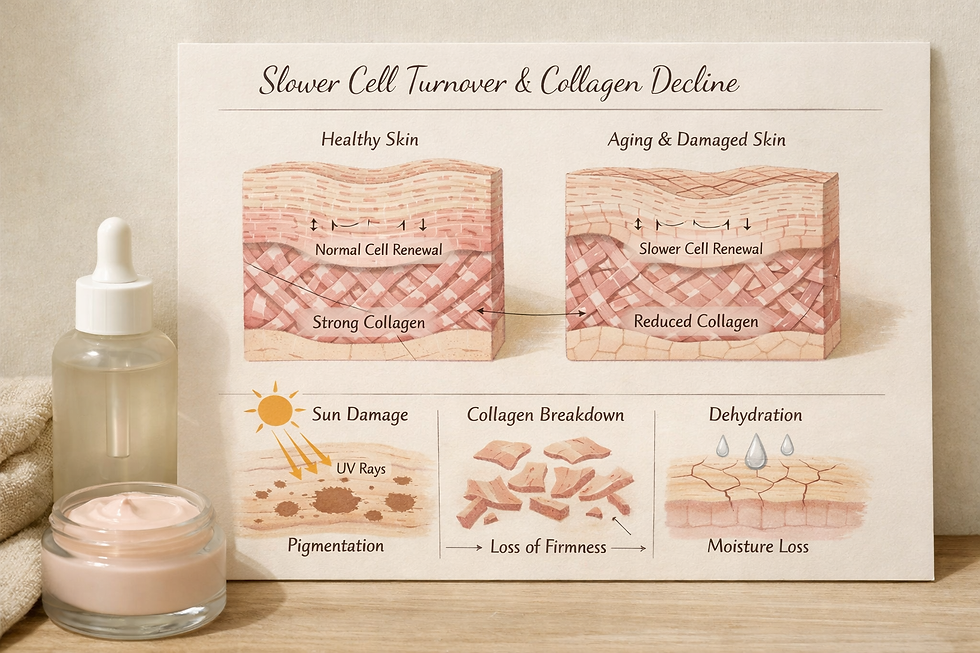
Radiance depends on three main things:
Smooth skin texture
Even hydration
Healthy light reflection
As we age, several natural changes interfere with this balance.
Slower cell turnover
In our twenties, skin renews itself roughly every 28 days. By our forties and fifties, this can slow to 45–60 days.
Dead cells linger on the surface, creating a rough layer that scatters light instead of reflecting it. The result is a muted, shadowed appearance.
Decreased collagen production
Collagen gives skin shape and elasticity. Production starts to go down in our twenties and lowers even more quickly throughout perimenopause and menopause.
Skin seems thinner and less bright when there is less support underneath.
Accumulated sun damage
Years of unplanned sun contact slowly change the color of your skin, cause tiny damage, and break down collagen. It only takes a little every day to build up over decades.
Dehydration
Mature skin produces less oil and holds water less efficiently. Hydrated cells reflect light beautifully. Dehydrated cells appear deflated and matte.
Together, these changes create the perfect conditions for dullness.
Your Step-by-Step Radiance Restoration Plan

The good news is that every one of these issues can be addressed gently and strategically.
Part 1: The Non-Negotiable Skincare Fundamentals
This is where real, visible change begins.

Step 1: Gentle, Effective Cleansing (Not Stripping)
One of the worst things for glow is harsh cleaners.
When the barrier on your skin is broken, water can leave your body more easily, inflammation rises, and your skin stays dull.
Choose cleansers described as:
Creamy
Milky
Hydrating
Barrier-supporting
Helpful ingredients include:
Ceramides
Glycerin
Hyaluronic acid
Oat extract
Your skin should feel comfortable after cleansing, never tight.
Step 2: Consistent Exfoliation (The Key to Brightness)

This is the step that will make your dull skin look better the most.
The dead-cell layer that stops light is taken off by exfoliation.
Chemical exfoliants (preferred)
These dissolve the bonds between old skin cells.
AHAs (glycolic, lactic): best for surface brightness
PHAs: gentler option for sensitive skin
Start 2–3 nights per week.
Physical exfoliants
They have to be very gentle if they are utilized. Don't use scrubs that are harsh or have pointy bits.
Too much exfoliation might create inflammation, which makes dullness worse in the end.
Step 3: Targeted Serums (Your Power Players)

Serums deliver concentrated ingredients deeper into the skin.
Vitamin C (morning)
Brightens tone
Protects from pollution
Helps fade dark spots
Supports collagen
Look for L-ascorbic acid or stable derivatives.
Hyaluronic acid
Draws water into skin
Plumps fine lines
Creates immediate glow
Retinoids (night).
The American Academy of Dermatology says that retinoids are one of the best long-term ingredients for:
Increasing cell turnover
Helping make collagen
Smoothing texture
Start slowly: 2–3 nights weekly.
Step 4: Deep Hydration with the Right Moisturiser

A moisturiser seals in your serums and repairs your barrier.
Look for:
Ceramides
Peptides
Niacinamide
Squalane
Cholesterol
You can think of moisturiser as the support that all the other steps need to work right.
Choosing the right formula matters see our detailed guide on the best moisturiser for mature skin.
Step 5: Sunscreen, Every Single Day
This step alone prevents most future dullness.
Broad-spectrum SPF 30+ protects:
Collagen
Pigment balance
Texture
Days with clouds are important too. Damages from UV rays builds up over time.
You may also find our guide on how to tell your skin type at home helpful before choosing products. How to Tell Your Skin Type: A Simple At-Home Test
Part 2: The Inside-Out Approach

Your skin reflects what is happening internally.
Hydration.
Skin cells require water to maintain shape and function. Aim for steady hydration throughout the day.
Nutrition.
Harvard Health Publishing says that foods that are high in antioxidants, good fats, and vitamins help the skin stay healthy and heal.
Focus on:
Berries and leafy greens
Sweet potatoes and peppers
Avocados and olive oil
Fatty fish
Sleep
During sleep:
Cell repair increases
Inflammation decreases
Barrier rebuilding peaks
7–9 hours is not indulgent. It is skincare.
Stress management.
Stress over time raises cortisol levels, which speeds up the breakdown of collagen and inhibits the healing process.
Even small habits help:
Walking
Stretching
Breathing exercises
Quiet time without screens
A Simple AM & PM Glow Routine Example
Morning
Gentle cleanse or water rinse
Vitamin C serum
Hyaluronic acid or light moisturiser
Sunscreen SPF 30+
Evening
Gentle cleanse
Exfoliant (2–3x weekly) or retinoid
Moisturiser
Consistency matters more than product price.
You can also follow our full morning vs night skincare routine for aging skin guide for detailed timing.
Radiance Routine Checklist (5-page PDF)
A simple morning + night checklist plus weekly tracker to help restore glow and hydration.
Best for: dullness, dehydration, busy routines
Download: 👉 Click Here
Frequently Asked Questions
How long until I see results?
Within one to two weeks, hydration and softness usually get better.
Over the course of 6 to 12 weeks, the texture and brightness get better.
It takes a few months for pigment and tiny lines to show up.
Is there a cheap way to fix dull pale skin?
Yes.
Focus on:
Gentle cleanser
Exfoliant or retinoid
Moisturiser
Sunscreen
Drugstore formulas can be excellent.
Is exfoliation safe for sensitive skin?
Yes, if gentle.
Use PHAs or lactic acid once weekly at first.
Does menopause make dullness worse?
Often, yes.
Hormonal shifts reduce oil production and slow repair, making barrier support and hydration even more important.
Accept the path to becoming your best self.
Fixing dull skin is not about erasing time.
It is about ensuring that your skin functions optimally.
Radiance does not mean flawless.
It means:
Comfortable skin
Even tone
Healthy reflection
Quiet confidence
Your skin will respond when you take care of it well and often.
Not right away.
But steadily.
And beautifully.
About the Author
Janerine Nevins is the founder and lead writer of Pearly Petal, a skincare education platform dedicated to evidence-based beauty for women over 40.
She has a background in Health and Social Care .
She combines scientific investigation with lived experience, navigating hormonal and age-related skin changes.
Her work is all about teaching people about skincare in a way that puts long-term skin health, emotional well-being, and making smart choices ahead of trends and false promises.
Editorial Standards & Content Integrity
At Pearly Petal:
Medical claims are cross-checked against peer-reviewed dermatology research
Product mentions are never paid placements
Affiliate relationships do not influence recommendations
Articles are reviewed annually or when guidance changes
Reader safety and factual accuracy come first
Medical & Affiliate Disclaimer.
These words are only meant to help you learn. They should not be taken as medical advice.
Before starting any new treatments, you should always talk to a qualified dermatologist or other health care source.
Some links may be affiliate links. These support independent research and content creation and never affect editorial integrity.
© 2026 Pearly Petal. All rights reserved.


Comments