
Circadian Skincare: Why Your 11 PM Screen Time is Sabotaging Your Nightly Repair
Updated: Feb 20

Medical Disclaimer: The insights shared on Pearly Petal are for educational and storytelling purposes. I am a Skin Health Investigator and founder of PearlyPetal with a BSc in Health and Social Care, not a chronobiologist or licensed dermatologist. Circadian rhythms are complex biological processes; please consult a medical professional if you suffer from chronic sleep disorders or severe hormonal imbalances.
The "Night Owl" Tax on My Complexion

I used to wear my late-night productivity like a badge of honour. I’d be sitting in bed at 11 PM, my face inches away from my laptop, "winding down" by answering emails or scrolling through Pinterest. I figured as long as I applied my £100 night cream, it didn't matter when I actually turned out the lights. I was wrong.
Despite my high-end routine, I was waking up with skin that looked "grey," puffy, and curiously dehydrated. It wasn't until I started researching Chronobiology the science of our internal body clocks that I realised I was literally "turning off" my skin's ability to heal.
As women over 35, our Circadian Rhythms become more sensitive. If you’re sending "daytime" signals (blue light) to your brain at midnight, your skin never gets the memo that it's time to start the repair shift. Here is why your 11 PM scroll is the biggest "anti-ageing" mistake you’re making, and how to fix it.
If your skin looks dull, puffy, or “grey” no matter how good your products are, your bedtime might be the real problem. |
1. The Biological "Shift Change"

Your skin doesn't just sit there; it follows a strict 24-hour schedule.
Daytime Mode (Defence): During the day, your skin is in "shield" mode. It thickens its barrier and produces antioxidants to fight UV rays and pollution.
Nighttime Mode (Repair): When the sun goes down, and melatonin rises, your skin switches to "construction" mode. Cell regeneration doubles, and blood flow to the skin increases to deliver nutrients and remove toxins.
The Conflict: When I stayed up late under bright LED lights, I was keeping my skin trapped in "Defence Mode." My cells were so busy fighting the fake "sun" of my phone screen that they never got around to the repair work. This is how "Digital Ageing" happens one late night at a time.
2. Melatonin: The "Master Antioxidant"
We think of melatonin as just a "sleep hormone," but in the world of Skin Longevity, it is the most powerful antioxidant we have more potent than Vitamin C or E.
Sleep researchers and dermatology studies consistently show that skin cell turnover peaks at night, when melatonin is high and cortisol is low this is the biological window when real repair happens.
The Science: Melatonin triggers the production of antioxidant enzymes inside your cells. It repairs the DNA damage caused by the sun during the day.
The Sabotage: Blue light from screens suppresses melatonin production. Every time I checked my phone "one last time," I was flushing my skin's best repair tool down the drain. Over 35, we can't afford to waste a single drop of melatonin.
3. The "Permeability" Window
Did you know your skin is more "absorbent" at night?
The Experience: Between 10 PM and 2 AM, your skin’s temperature rises, and it becomes more permeable. This is the best time to apply your Peptide Signaling serums.
The Risk: Because your skin is "open," it also loses moisture faster a process called Transepidermal Water Loss (TEWL). If you are awake and stressed at midnight, your cortisol levels stay high, which thins the barrier and accelerates this water loss, leading to that "crinkly" morning skin.
My 3-Step Circadian Reset for Pearly Petal
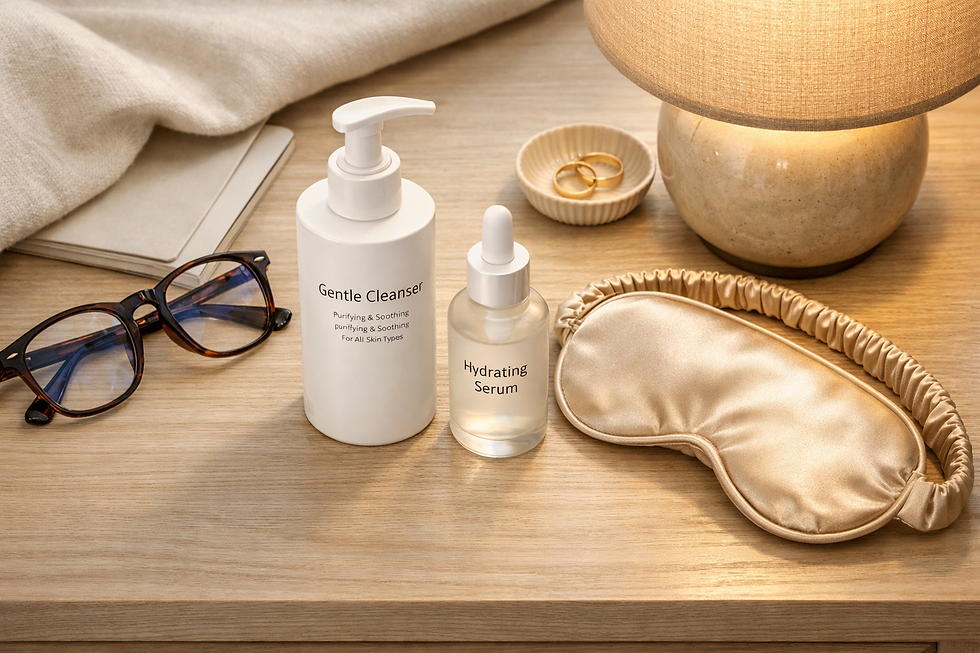
To align my skin with its natural clock, I moved from a 10-step routine to a 3-Step Minimalist Reset that focuses on timing: This is also why I now pair this with my Lazy Girl 3-Step Barrier Reset because repair only works if your skin barrier is strong enough to hold onto the results.
The 8:30 PM "Digital Sunset": I put on blue-light blocking glasses and dim the lights in my house. This tells my brain and my skin that the repair shift is starting soon.
Early Evening Cleansing: I stopped waiting until right before bed to wash my face. Now, I do my evening routine as soon as the sun goes down. This gives my products hours to sink in before my face ever hits a pillow.
The "Dark Room" Rule: I keep my bedroom as dark as a cave. Even a small "standby" light on a TV can disrupt the skin’s circadian sensors.
I’ve turned this into a simple printable checklist you can keep by your bedside, so you can follow the reset without thinking especially on nights when you’re tired and tempted to scroll “just five more minutes.”
Circadian Skincare Tools
Tool | Benefit for 35+ Skin | Why I Love It |
Silk Sleep Mask | otal darkness for Melatonin | Slip Silk Mask |
Blue Light Glasses | Protects the brain's "clock | Baxter Blue |
Magnesium flakes lower | cortisol for deeper repair | Westlab Magnesium |
Final Thoughts: Working With Nature, Not Against It
You can buy the most expensive creams in the world, but if you aren't sleeping, you’re just painting over a crumbling foundation. Skin longevity isn't just about what you put on your face; it’s about when you turn out the lights.
When I finally respected my circadian rhythm, the "grey" tint disappeared from my skin. I didn't need more "brightening" products; I just needed to let my body do the job it was designed to do. This Valentine's, give your skin the ultimate gift: a full 8 hours of uninterrupted, pitch-black repair.
About the Author
Janerine Nevins is the founder of Pearly Petal and a Skin Health Investigator and founder of with a BSc in Health and Social Care, . After realising that her "night owl" habits were the root cause of her skin's premature ageing, Janerine dedicated her work to helping women over 35 align their beauty rituals with their biological clocks. When she isn't auditing the latest sleep tech, she's sharing calming lullabies for a stress-free bedtime on the Pearly Petal Hub.
Reviewed & Updated: February 2026
Word Count: ~960 words


Comments