
The Best Foods for Skin Barrier Repair After 35 (And What to Avoid)

By Janerine Nevins | Founder of Pearly Petal
Last Updated: February 2025
Estimated Read Time: 12–14 minutes
Medical Disclaimer: The nutritional advice on Pearly Petal is meant to teach and improve your living. I am Skin Health Investigator, and not a registered dietitian or doctor. Nutrition is very personal. Before making big changes to your food, you should always talk to your doctor or a nurse, especially if you already have a health problem.
The Week My Skin Taught Me a Hard Lesson
On one of those cold, grey February mornings in the UK, I stood in front of my bathroom mirror and wondered why my skin suddenly looked… defeated. Not just dry fragile. My cheeks stung when I rinsed them. My regular "gentle" serum hurt. Makeup was like chalk on my face.
I had been doing everything "right" on the exterior, such using barrier creams, ceramides, and simple routines. But the redness and tightness kept coming back.
That’s when it hit me: my skin barrier wasn’t just struggling on my face it was struggling in my kitchen.
After 35, our skin becomes thinner, slower to repair, and more sensitive to inflammation. You can apply the best moisturiser in the world, but if your body doesn’t have the raw materials to rebuild the barrier, you’re patching cracks instead of fixing the wall.
This is the article I wish I’d read back then the real-life, food-first guide to repairing your skin barrier after 35.
What Is the Skin Barrier (And Why Does It Get Weaker After 35)?

Your skin barrier is the outermost layer of your skin. Think of it like a brick wall:
The skin cells are the bricks
The lipids (fats) are the mortar
Together, they keep water in and irritants out
After 35, a few things start to change:
Ceramide production slows
Collagen and elastin decline
Inflammation (“inflammaging”) increases
Recovery from stress, weather, exfoliation, and hormones takes longer
The result?
More dryness
More sensitivity
More redness
More breakouts or flare-ups
Makeup that suddenly looks terrible
Even though creams and oils help, your body still needs the building blocks to repair that wall from the inside.
The “Feed the Wall” Principle
Here’s the mindset shift that changed my skin:
Barrier repair isn’t just skincare. Its construction. And construction needs materials.
Your skin barrier needs:
Healthy fats
Amino acids (from protein)
Antioxidants
Minerals like zinc
Anti-inflammatory compounds
Enough energy to actually repair
When I started eating for barrier repair, not just for “health,” my skin stopped feeling like it was constantly on the edge of a meltdown.
The Best Foods for Skin Barrier Repair After 35
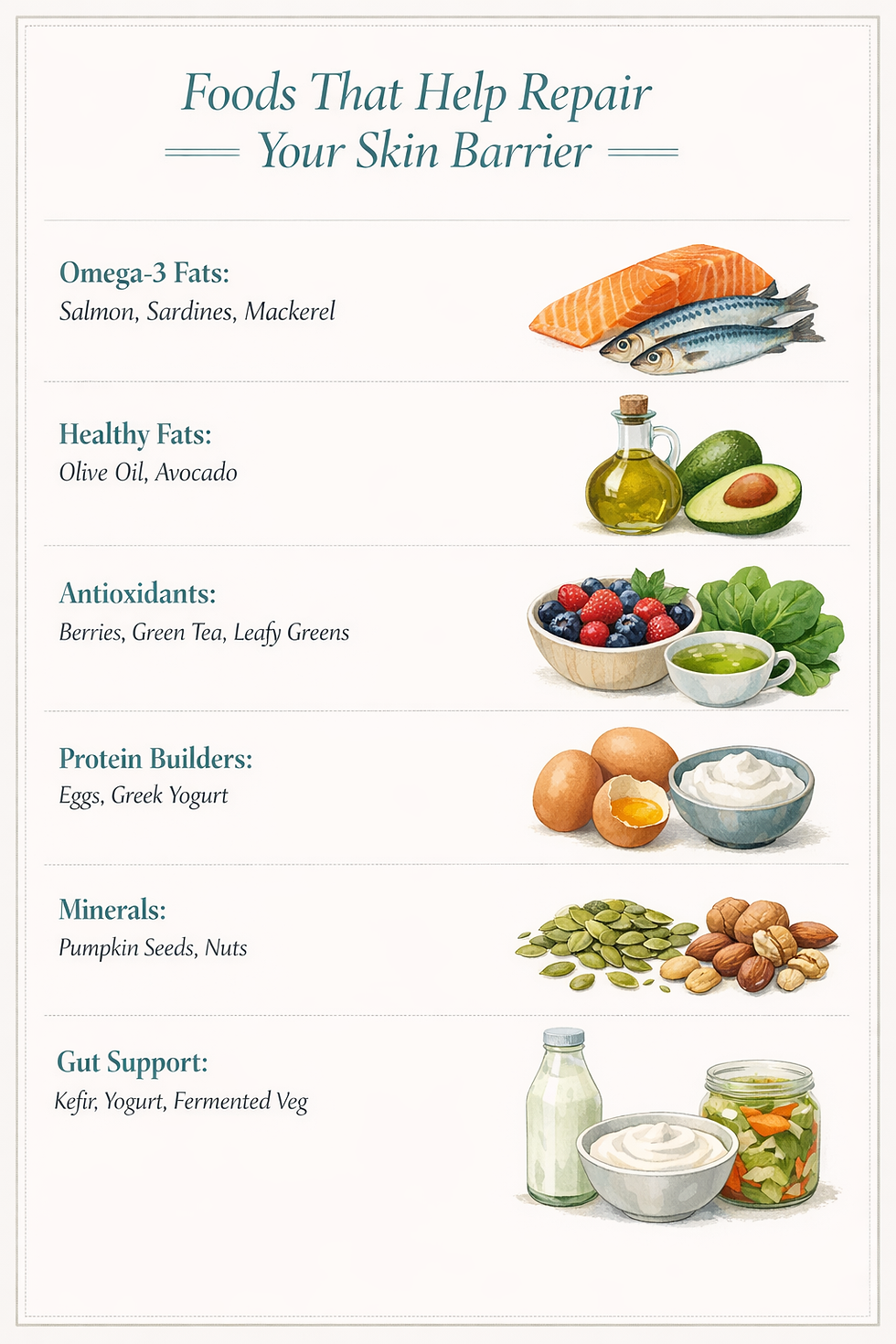
1. Fatty Fish (The Lipid Rebuilders)
According to studies published in the Journal of Clinical Medicine, Omega-3 fatty acids are essential for maintaining the structural integrity of the skin's lipid barrier.
Think: salmon, sardines, mackerel, anchovies, herring.
Why they help:
These are rich in omega-3 fatty acids, which:
Reduce inflammation
Support the lipid layer of the skin
Help calm redness and sensitivity
Improve moisture retention
Human truth:
When I eat oily fish 2–3 times a week, my skin feels less reactive. Fewer random stinging days. Fewer “why does my face hate everything?” mornings.
2. Extra Virgin Olive Oil (The Anti-Inflammatory Fat)
Why it helps:
Olive oil has oleocanthal in it, which is a Skin Health Investigator an anti-inflammatory properties. While it is a food and not a drug, research suggests it may support the body's natural inflammatory response. .
Use it:
On salads
For gentle cooking
As a daily fat source
This is one of the quiet heroes of barrier-friendly diets.
3. Avocados (The Moisture Supporters)
Why they help:
Avocados provide:
Monounsaturated fats
Vitamin E
Carotenoids
These support:
Skin elasticity
Lipid balance
Protection against oxidative stress
Pro-tip from my own mistakes:
Don’t fear fats if your skin is dry and sensitive. After just a few weeks of trying to "eat low-fat," my skin became drier, duller, and more sensitive.
4. Berries The Protectors of Collagen
Think: blueberries, blackcurrants, elderberries, strawberries.
Why they help:
They’re rich in anthocyanins and vitamin C, which:
Protect collagen from breakdown
Reduce oxidative stress
Support skin repair processes
My habit:
Greek yogurt with frozen berries has protein to help repair and antioxidants to protect. When I don't take these, my skin really does seem more fatigued by the end of the day.
5. Pumpkin Seeds (The Zinc Boosters)
Research in the American Journal of Clinical Dermatology highlights zinc as a critical mineral for the skin's enzymatic repair processes.
Why they help:
Zinc is essential for:
Skin healing
Barrier repair
Inflammation control
Regulating oil and breakouts
Low zinc = slower healing and weaker barrier.
Just a small handful a few times a week makes a difference over time.
6. Eggs (The Repair Protein)
Why they help:
Eggs provide:
Complete protein (amino acids = building blocks for skin)
Biotin
Choline
If your diet is low in protein, your skin literally can’t rebuild efficiently.
7. Fermented Foods (The Gut–Skin Support)
Think: kefir, yoghurt, kimchi, sauerkraut, miso.
Why they help:
Emerging research into the gut-skin axis suggests that a balanced microbiome may help support a calmer complexion and reduce the frequency of sensitivity-related flare-ups
Less systemic inflammation
Fewer skin flare-ups
Better tolerance to skincare products
This isn’t magic it’s biology plus consistency.
8. Green Tea & Matcha (The Calm-Down Drinks)
Why they help:
They contain EGCG, a powerful antioxidant that:
Reduces inflammation
Protects skin cells from stress
Supports overall skin resilience
Within weeks, I found that my afternoon redness flares were less frequent once I switched my second coffee for green tea.
What to Avoid (If Your Barrier Is Struggling)

This isn’t about perfection it’s about patterns.
1. Highly Refined Seed Oils
Excess omega-6 without enough omega-3 can fuel inflammation. This doesn’t mean eat them but balance matters.
2. Ultra-Processed, High-Sugar Diets
High sugar spikes:
Increase inflammation
Damage collagen through glycation
Make skin heal more slowly
My skin always looks duller and more reactive after a few “busy weeks” of convenience food.
3. Too Much Alcohol
Alcohol:
Dehydrates the skin
Disrupts sleep (when skin repairs itself)
Increases facial redness and sensitivity
4. Foods You Personally React To
For some people, that’s certain dairy. For others, it’s gluten or ultra-processed snacks. Your skin will usually tell you listen to it.

Free Download: 7-Day Skin Barrier Repair Food Checklist
I created a simple, printable guide you can keep in your kitchen or save on your phone. It shows exactly what to eat, what to limit, and how to support your skin barrier from the inside out without dieting or extremes.
The 7-Day Skin Barrier Support Approach (Realistic Version)
This isn’t a cleanse. It’s not extreme. It’s supportive.
Eat a protein source at every meal
Include a healthy fat daily
Add at least one antioxidant-rich food per meal
Drink enough water
Reduce ultra-processed foods where you can
Keep it boringly consistent
Final Thoughts: Your Skin Is Built, Not Just Treated
After 35, having healthy skin isn't about trying to be perfect. It's all about being strong.
Your creams are important. Your routines are important.
But what you eat, how you drink, and how you recover all play a big role in how robust your skin barrier can get.
The stinging went away when I stopped trying to "fix" my face and started giving it the right food. The tightness went away. And for the first time in years, my skin felt like it could handle life again.
About the Author
Janerine Nevins is the founder of Pearly Petal and a skincare researcher focused on skin longevity, barrier repair, and realistic routines for women over 35. With a background in Health and Social Care, Janerine connects Skin Health Investigator with real-life experience to help women get stronger, calmer, and more resilient skin using gentle, science-based methods.


Comments